



Company Registration in India - Fast & Affordable Online Process
Starting a business in India begins with the right foundation — company registration. Whether you're launching a startup, partnership, or solo venture, registering your company legally ensures credibility, compliance, and growth opportunities.
We help you register your company online in India with a smooth, guided process handled by experienced professionals. From documentation to government approvals — everything is managed end-to-end.
Get Free Consultation
Fill the form and our expert will guide you through the entire process
What is Company Registration?
Company registration in India is the legal process of incorporating a business entity under the Companies Act, 2013, through the Ministry of Corporate Affairs (MCA). Once registered, your business becomes a separate legal identity, enjoys limited liability protection, and gains the right to own assets, sign contracts, open bank accounts, and raise capital.
- Legal recognition of your business
- Limited liability protection
- Easier access to funding and investors
- Tax advantages and deductions
- Increased brand credibility
- Perpetual succession (business continuity)
Types of Company Registration in India
India recognises 10 main business structures. Each has its own registration route, compliance load, and tax treatment. Pick the one that matches how you plan to operate, raise, and scale.
1. Private Limited Company
The default choice for startups and growth businesses. Limited liability, a separate legal identity, and the ability to issue equity shares to angel and VC investors — all under the Companies Act, 2013. Launching a startup or planning to raise? Private Limited Company registration is the format most funded founders choose.
2. Limited Liability Partnership (LLP)
Best for professionals and service firms that want partnership flexibility with limited liability. Governed by the LLP Act, 2008. Lower compliance cost than a Pvt Ltd, no dividend distribution tax. Two designated partners can file an LLP registration online and be operational in under two weeks.
3. One Person Company (OPC)
A solo founder's version of a Private Limited Company — single-member ownership with limited liability and a separate legal identity. Ideal for consultants and first-time founders who want corporate protection without co-founders. Under Section 3(1)(c) of the Companies Act, 2013, One Person Company registration requires just one member and one nominee — no co-founder needed.
4. Public Limited Company
Designed for businesses planning to list on a stock exchange or raise capital from the public. Minimum 7 shareholders, 3 directors, and no upper limit on members. Heavier compliance, higher credibility. Planning to scale beyond private capital? Public Limited Company registration is the structure for you.
5. Sole Proprietorship
The simplest business setup in India. Single owner, full control, minimal paperwork — but unlimited personal liability. Set up via GST, MSME/Udyam, or Shop & Establishment registration rather than through MCA. Freelancers, traders, and local shops can register as a sole proprietor in 3–5 working days.
6. Partnership Firm
Two or more partners sharing profits, losses, and responsibilities under the Indian Partnership Act, 1932. Registration is optional but strongly recommended; unregistered partnerships cannot sue each other in court. A formal partnership firm registration closes that legal gap and protects every partner.
7. Section 8 Company
The structure for non-profits — NGOs, charities, and social enterprises promoting education, art, science, commerce, or social welfare under Section 8 of the Companies Act, 2013. Tax-exempt under Sections 12A and 80G with a separate application. Building a non-profit? Section 8 company registration is the route to take.
8. Nidhi Company
A mutual benefit company for encouraging savings among members, registered under Section 406 of the Companies Act, 2013. Accepts deposits and lends only within its member base. Community savings groups can register a Nidhi Company to formalise member-only deposits and loans without separate RBI licensing.
9. Producer Company
Built for farmers, agriculturists, and producer groups. Pools resources, strengthens bargaining power, and enables collective processing and marketing. Agricultural collectives can apply for producer company registration and unlock collective bargaining benefits unavailable to unregistered groups.
10. Startup India
Not a separate company structure — a DPIIT recognition layered on top of your Pvt Ltd, LLP, or OPC. Unlocks a 3-year income tax holiday under Section 80-IAC, fast-track IP filing, self-certification under 9 labour laws, and access to the ₹10,000 crore Fund of Funds. Eligible founders can apply for Startup India recognition without changing their existing structure.
5 Most-Chosen Company Structures in India: Primary Difference
Almost 90% of registrations on the MCA portal fall into five structures. This quick matrix helps you shortlist before you commit.
| Company Type | Key Features | Liability | Best For | Taxation |
|---|---|---|---|---|
| Private Limited Company | Separate legal entity, easy to raise equity, strong credibility | Limited to shares held | Startups, funded ventures, growth businesses | 22% / 25% / 30% corporate tax (turnover and option-based); eligible for 115BAA |
| One Person Company (OPC) | Single-member ownership, limited liability, corporate identity | Limited to the capital contributed | Solo founders, freelance consultants | Taxed like a Pvt Ltd; simple filings |


Benefits of Company Registration
 Legal recognition of your businessLimited liability protectionEasier access to funding and investorsTax advantages and deductionsIncreased brand credibilityPerpetual succession (business continuity)
Documents Required for Company Registration

For Directors
For Registered Office
Step-by-Step Process of Company Registration
Choose Company Type
Select the right structure (Pvt Ltd, LLP, OPC, etc.)
Name Approval
We check and reserve your company name with MCA.
Documentation
Submit KYC and address proof documents.
Filing with MCA
We handle incorporation filing and compliance.
Certificate of Incorporation
Receive your company registration certificate and start operations.
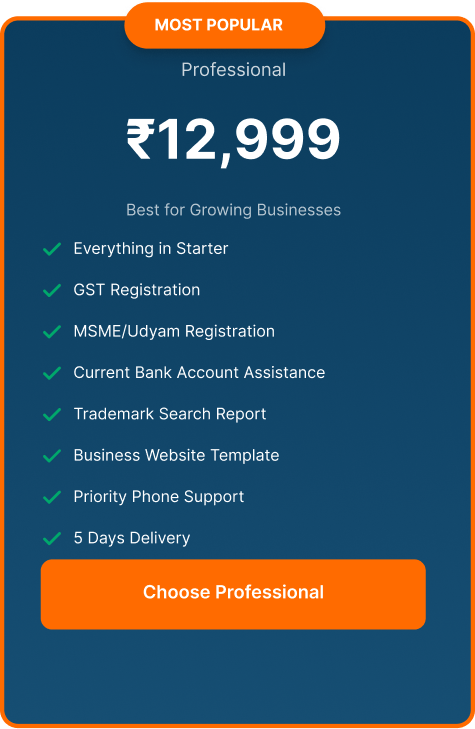
Company Registration Fees in India
The cost of company registration depends on the type of business and services included.
Basic Registration
Standard Package
Premium Package
*Prices may vary based on requirements and government fees
How Long Does Company Registration Take?

Why Choose Us for Company Registration?

Fast and hassle-free process

Affordable pricing with no hidden charges

Expert CA/CS support

100% online registration

Dedicated account manager

End-to-end compliance assistance
FAQs on Company Registration
A Section 8 Company is registered under the Companies Act and operates across India. A Trust is governed by the Indian Trusts Act for charitable purposes. A Society is registered under the Societies Registration Act and needs a minimum of 7 members.
Yes, but only after obtaining FCRA (Foreign Contribution Regulation Act) registration, which requires a minimum of 3 years of operational history.
12A registration exempts the NGO's income from tax. 80G registration allows donors to claim tax deductions on their donations to your NGO.
A minimum of 7 members from different families are required to register a Society in India.
Start Your Company Today
Register your company in India with a trusted partner and turn your idea into a legal business.
Need help choosing?

Call us at +91 9582527282
Get Free Consultation
Fill the form and our expert will guide you through the entire process
Ready to Register Your Company?
👉 Get started now with expert assistance and zero hassle.
